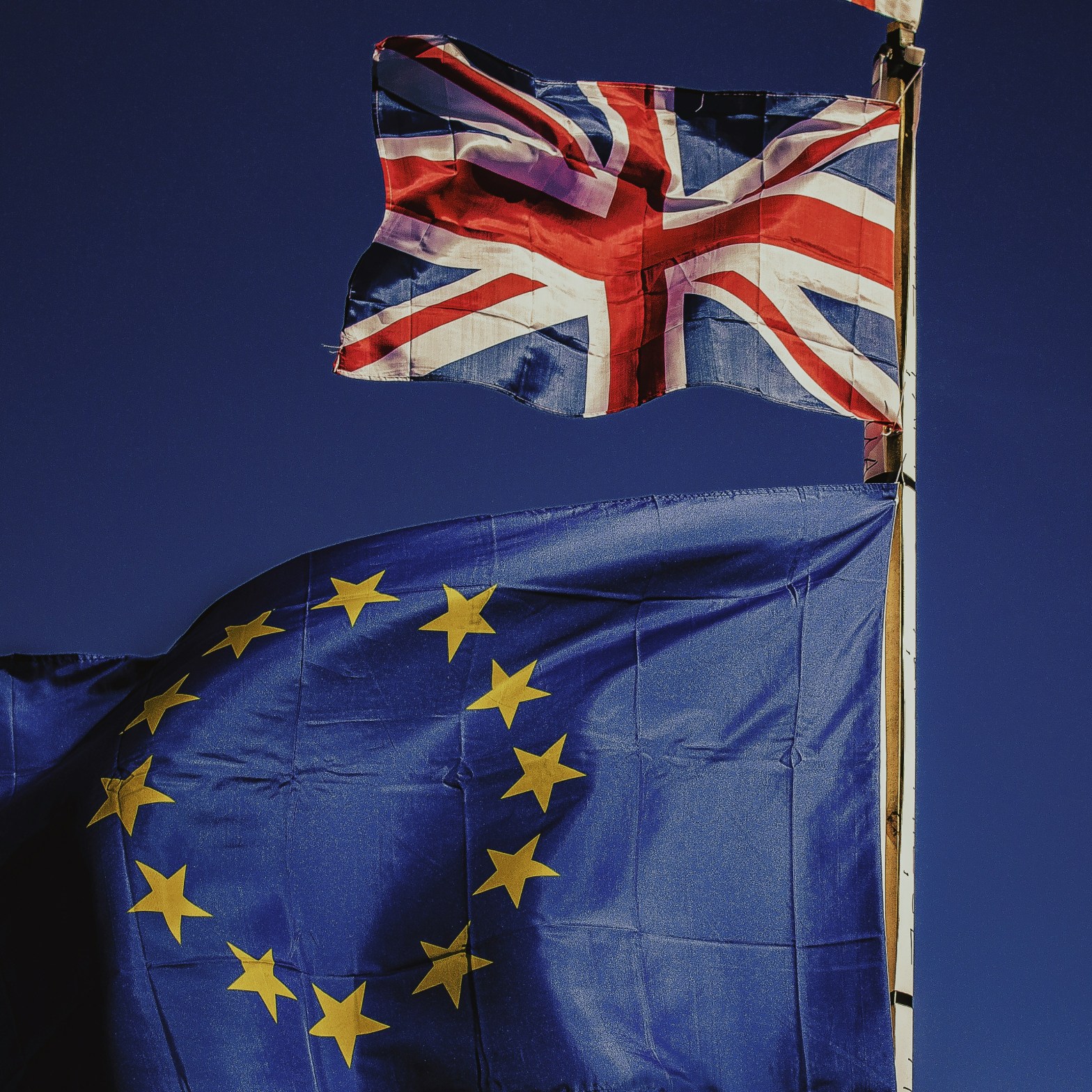
Brexit is haunting modern Britain from the shadows. It has been the political football tossed around the streets, and the House of Commons, for nearly a decade with no satisfactory endgame. However, the latest diplomatic rift with Washington has forced a strategic hand.
In the wake of Donald Trump’s military action in Iran, and his subsequent criticism and mockery of the Prime Minister for not providing offensive support, PM Starmer has signalled a major pivot towards a closer partnership with Europe and the EU.[1] It seems that the phantom may yet be re-corporealised.

Photo by Simon Dawson / No 10 Downing Street. © Crown copyright, licensed under Open Government Licence v3.0 via Wikimedia Commons.
How did we get here? It is fatiguing and dispiriting to recall Britain before Brexit. But the tension on the ‘Special Relationship’ has forced introspection. Given that the structural effects of Brexit have amounted to a chronic, slow-burn erosion of the UK economy,[2] why is it that a majority of the public voted to leave the European Union? Particularly if we now, only ten years later, are forced to reconsider?
To understand this impulse, we must begin with the direct consequences—the collateral damage—of Neoliberalism, Britain’s economic ideology since the 1980s. It is within those decades of structural degradation that we might find the answer as to why the public, in 2016, voted for what economists forecast as an act of economic self-harm.[3]

Photo by Johannes Plenio via Pexels.
More Than A Protest
‘This was more than a protest against the career opportunities that never knock and the affordable homes that never get built. It was a protest against the economic model that has been in place for the past three decades,’[4] wrote Larry Elliott for the Guardian, three days after the Brexit vote in June 2016. And, indeed, the perception of Brexit from its champions has been that of a kind of ‘people’s revolt’ against a monolithic global elite.[5]
According to a study by Alabrese, Becker, Fetzer & Novy, there was a clear correlation between low educational attainment, unemployment (or employment in declining industries like Manufacturing), a lack of quality of public service provision and the decision to vote to leave the European Union.[6] In other words, a decisive majority of traditional working-class voters voted Leave. According to a Lord Ashcroft poll, the only socio-economic groups voting with a clear majority for Remain were professional, managerial and administrative demographics.[7]

For traditional working-class voters, we could interpret their Leave vote as a reaction against what the system had been offering them, and how their prospects had been unfolding under the economic, political consensus of the time.
So, what is Neoliberalism, the dominant economic and political ideology of the UK since the 1980s? And how did it create a demographic of dissatisfied voters Ford & Goodwin have called ‘the left-behinds?’[8]
Neoliberalism, Globalization & The ‘Left-Behinds’

Photo by Maxim Hopman on Unsplash.
Neoliberalism is a market ideology favouring decentralization, deregulation, and open borders for trade. Globalization acts as a process of reinforcement for this; increasing international integration, facilitating the rise of the transnational corporations (TNCs) and diminishing the economic (and political) influence of the nation-state.[9] The effect is an increasing ‘deference’ of the nation-state to international capital.
Though Globalization has always existed in one form or another, Margaret Thatcher’s government integrated the UK economy more openly into global trade through privatization; meaning that, ultimately, four years into her eleven year term, the UK had become a net importer of manufacturing for the first time in two centuries.[10]

Portrait of Margaret Thatcher (c. 1995).
Original photo by Terence Donovan via the Margaret Thatcher Foundation; derivative work by Begoon. Released by the Thatcher Estate for unrestricted use.
Thatcherism facilitated de-industrialization, and the economy’s modern dependence on the financial sector, by appealing to monetarism (the preference of capital-as-money over capital-as-production). Proliferating through a program of opening up government shareholdings and nationalised industries (the lifeblood of many working-class communities), Thatcherism allowed international capital to penetrate the UK economy from overseas.[11]
This change killed off national enterprises so that, by the late 90s / early 20s, ‘crown jewel’ UK businesses like Rolls Royce, Thames Water, Powergen and O2, had entirely foreign ownership.
Describing Thatcherism for The New Statesman in 2019, David Edgerton (Professor of Modern British History) opined: ‘How did the most successful conservative party of the 20th century become the agent for a national humiliation?’ [12] This sentiment echoes the weary public criticism in 1997, which helped deliver a decisive victory to Tony Blair’s ‘New Labour.’
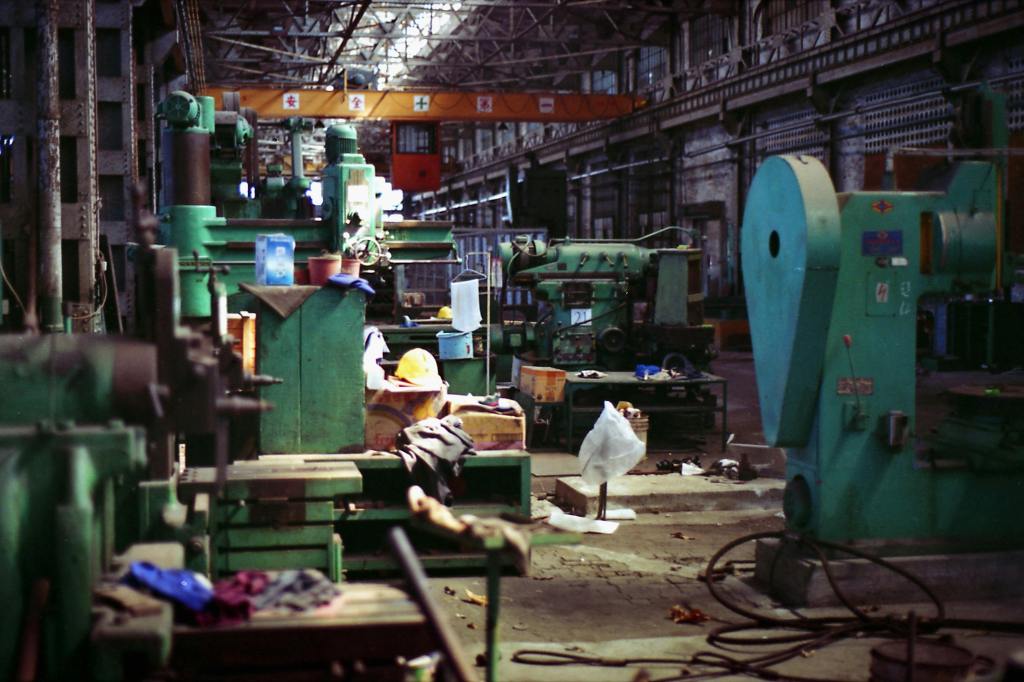
Photo by Alan Wang via Pexels.
As a consequence of privatization and a deregulated market, the larger pool of international competition pressured employers to hold down the costs of production, as well as allowing them to outsource to lower-cost countries, with the omnipresent threat of outsourcing degrading the bargaining power of unions and workers.[13] The closure of national industries in favour of imports, with no subsequent retraining or equivalent employment, lead to a decimation of regional communities, and by the second year of Thatcher’s second term, unemployment had more than doubled.[14]
Thatcher’s programs of deregulation and privatization (ostensibly promoted to improve the efficiency of the public sector via ‘survival of the fittest’ for market forces[15]) eroded the ‘post-war settlement,’ which had pursued full-employment, welfare support systems, the National Health Service and free higher education, transforming the lives of working-class people. Thatcher’s policies, Hall suggests, betray the true intentions of Neoliberalism as a ‘direct attack’ on the post-war welfare state.[16]
Through cuts directed at housing, education and personal social services, this ideological ‘attack’ hit vulnerable communities the hardest (the proportion of pensioners living below the poverty line rose from 13% to 43% and child poverty doubled.) British journalist and social policy expert Malcolm Dean, best known as the creator of The Guardian’s Society pages, summed up the situation as follows: ‘In 1979 the post-tax income of the top 10% of the population was five times that of the bottom 10%; by 1997 it had doubled to 10 times as much. After three decades during which economic growth was shared across income groups, the distribution went into reverse.’[17]

Photo by BEN ELLIOTT on Unsplash.
The Thatcher government also pursued new restrictions on trade unions, forbidding organized protests, allowing employers to dismiss strikers, and making unions liable for financial penalties, effectively ending collective action.[18] So, on top of the crumbling welfare state, working-class communities were also chronically underrepresented, seemingly abandoned by a state which appeared to have forgotten them. As Nunn argues, we may see the long-term project of Thatcherism as a fundamental weakening of the working-class in economic and political representation.[19] The effects of which were arguably only superficially addressed by successive New Labour and Conservative governments who, at most, minimized the excess without charting a new path.
Thus, Thatcherism halted the productive sphere of the UK economy in favour of finance capital and imports, and focused government policy on distancing trade unions from the state and meeting TNC demands. In 1986, Thatcher’s government opened up the London Stock Exchange to foreign investors, dubbed ‘The Big Bang,’ transforming the capital into a global financial hub.

Photo by Oliver Hale on Unsplash.
This unprecedented growth of financial capital fundamentally reshaped London, transforming its top earners into a new class of ‘super-earners;’ but, as a consequence, it also significantly widened the North-South economic gap.
‘Global Cities’ and the Regional Divide
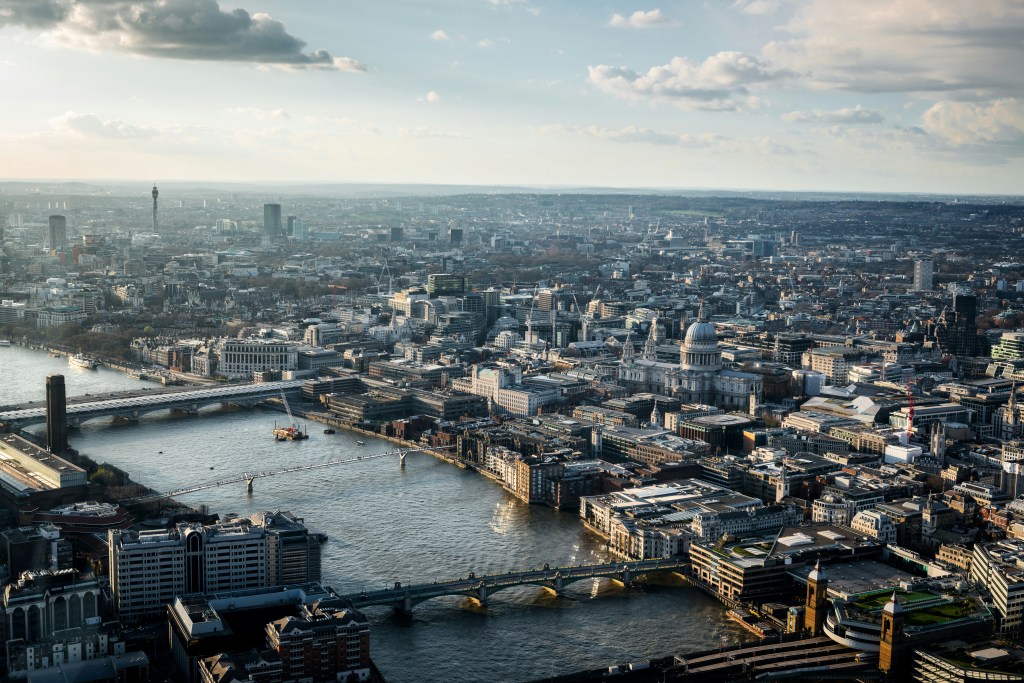
Photo by Andres Garcia on Unsplash.
Thatcherism’s de-industrialization and dependence on finance capital has seen the emergence of ‘global cities’ in transnational trade as the western economy’s lynchpin.
Noah Toly, a former Senior Fellow for Global Cities at the Chicago Council on Global Affairs, defines global cities as a necessity in our open, international economic system, concentrating large numbers of this borderless economy’s ‘winners,’ and developing unparalleled levels of political influence.[20] They represent ‘nodes’ in a network of TNC activity around the globe.
London, for example, by virtue of its density of people and historical institutions, was successfully marketed as a financial centre after the ‘The Big Bang.’ This deregulation of the London Stock Exchange (abolishing fixed commissions, ending the separation between brokers and dealers, and allowing foreign ownership) engineered a framework designed to attract global private investment above all else.[21] This shift fundamentally altered the British state’s role. Today, unlike most developed countries, the UK relies primarily on the private sector to finance its core infrastructure.[22] This leaves national development uniquely at the mercy of private enterprise, exemplified by one of the world’s only fully privatised water systems.[23]
The resulting accumulation of finance capital in the City has ensured that job creation remains overwhelmingly lopsided. London and the South-East, representing only a quarter of the population, have accounted for almost a third of net job growth since the 2008 financial crash, with precarious ‘gig economy’ service roles comprising a disproportionate number of these new positions.[24]

Photo by Szymon Shields on Unsplash.
Toly’s analysis reminds us that this dichotomy of the affluence of global cities in comparison to the struggling ‘hinterlands’ is a vital lens through which to view the Brexit vote.[25] Research by Dijkstra, Poelman & Rodríguez-Pose suggests that the ‘geography of discontent,’ prevalent in post-industrial towns burdened by low educational attainment and stagnant employment, correlates statistically with high densities of regional Leave votes.[26] Their findings indicate that anti-EU sentiment was not a sudden fever, but a symptom of long-term economic decline. As Dijkstra et al. argue, these ‘places that don’t matter’ often hail from the very industrial heartlands that were dismantled to make way for the London-centric, finance-led model of the Thatcher years.[27]
One stark indication of the regional divide is a disparity in mortality rates. Populations in the richest parts of London and the South-East in have very low mortality rates, whereas those in post-industrial areas of the North (Blackpool, Hull and Liverpool among them) have rates statistically closer to parts of Poland and Turkey than London.[28]
Former Prime Minister Gordon Brown once referred to the UK as ‘united in name only.’[29] In the wake of the Brexit vote, Brown described a ‘revolt of the regions’ against London’s failure to ‘trickle-down’ or disperse wealth regionally.[30] However, Brown’s own New Labour government marketed themselves to affluent metropolitan workers, failing to address post-industrial anxieties or reverse Thatcher’s union sanctions.[31]

Photo by Peter Hall on Unsplash.
Thomas Freidman, a journalist for The New York Times, optimistically argued that technological advances have ‘flattened’ economic opportunity in our global era.[32] The evidence, on the other hand, speaks more to his rival, Richard Florida’s, counter-argument that the economy has ‘peaks,’ in metropolitan innovation centres like London, which have become more dispersed; while the distance between talent-exporting ‘have-not’ regions, and developed, ‘have,’ capitals has grown.[33] As Dörry & Dysmki note, London’s intricate economic relationship with Europe and heavy nourishing by the single market, allowed the city to emerge as a financial powerhouse.[34] A powerhouse which, by the 2016 Bexit referendum, generated 22.7% of the UK’s total GVA (Gross Value Added), while the entire North East region contributed just 3.0% (a nearly eightfold disparity in economic weight).[35]
Despite its stark internal inequality (where the immense wealth of the London Stock Exchange is counterbalanced by a sprawling, precarious service economy), London functions as a classic example of what Dörry & Dysmki call an ‘archipelago-economy’[36]). It successfully materialises high-speed capital flows through a unique ecosystem of merchant banks, capital brokers, and dense clusters of professional expertise, acting as a kind of ‘suction’ for national resources, with regional areas frequently see their talented workers and economic resources syphoned away towards the metropolitan core.
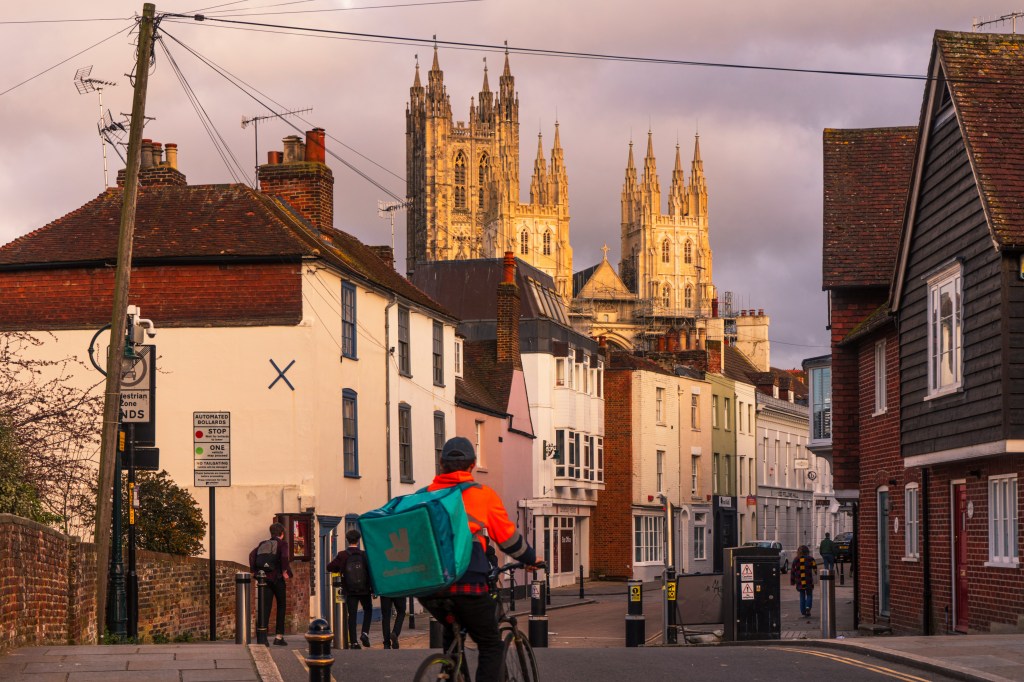
Photo by Jeffrey Zhang on Unsplash.
Access to the single market allowed London-based firms to conduct direct trade with the EU through passporting rights and euro-dominated bonds and shares, but the loss of the single market formally ended passporting rights for London firms, forcing them to relocate assets and staff (estimated at over £900 billion) to EU hubs. While London has retained its ‘pool of liquidity’ and global expertise, it now operates as a ‘third country,’ increasingly vulnerable to regulatory shifts in the Eurozone and the looming 2028 deadline for the repatriation of euro-denominated clearing.[37] As Sean O’Grady dryly remarked for The Independent in 2017: ‘house prices, fancy restaurants, luxury car dealers and champagne sales in London would be hit.’[38] Perhaps, in this small way, the ‘revolt of the regions’ was a success; a substantiating of discontent if nothing else. However, as the UK economy struggles with lower investment and productivity, this ‘revolt’ has perhaps caused a collective ‘levelling down,’ rather than the regional ‘levelling up’ voters may have truly desired.
From this, we can conclude that a key accelerant for the flames of the Brexit vote calcified over regional animosity towards London into a specific attack on London-based firms benefitting massively from the intersection of transnational capital; a ‘revenge of the places that don’t matter,’[39] which prioritised the re-assertion of national borders even at the cost of global financial supremacy.

Photo by Jeffrey Zhang on Unsplash.
The Political Liability of a Borderless World
The key point of articulation on the road to the Brexit vote seems to have been the 2008 financial crisis. Spanish-American sociologist and political economist Mauro Guillén describes a dynamic where blue-collar workers have simply ceased to buy into the values of middle class professionalism, and the liberalism of the political and media classes has come to be associated with the negative consequences of trade, capital movements, migration and technology.[40] Middle-brow liberalism becomes a proxy for an ineffable political/economic system.
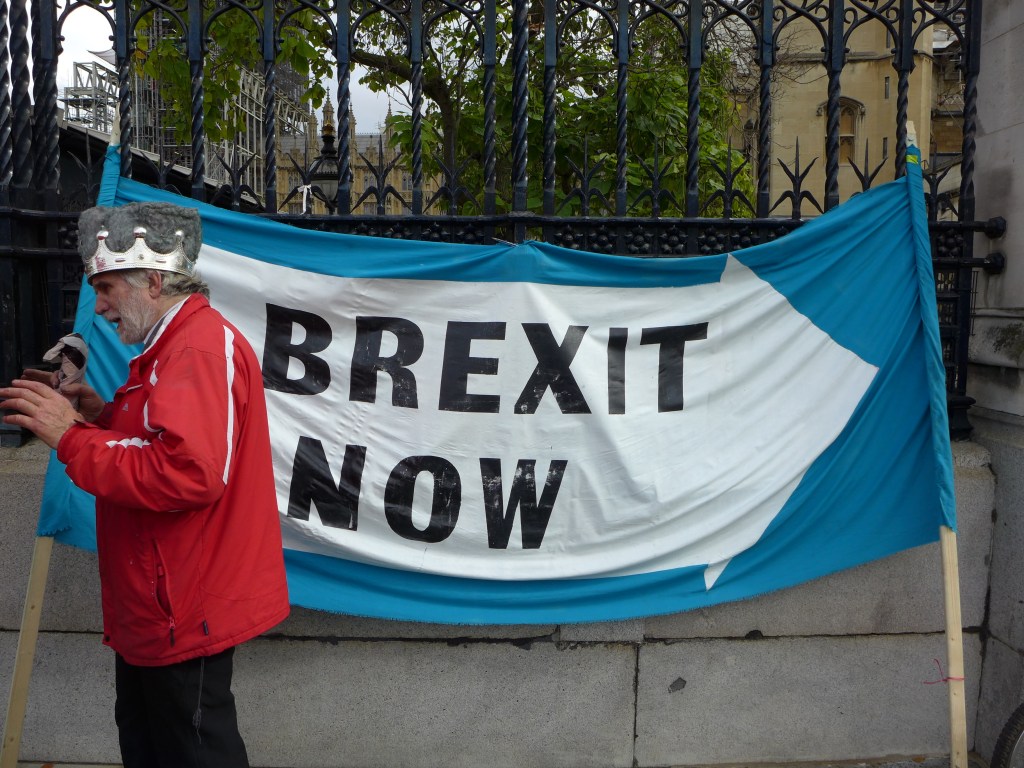
Photo by ChiralJon, licensed under CC BY 2.0 via Wikimedia Commons.
Ford & Goodwin write of a growing divide between the traditional working-class and emerging social groups such as ethnic minorities, graduates, and middle-class professionals, holding very different values from the ‘once-dominant but now fast-declining’ demographics (older, white voters, traditional working class people and school leavers).[41]
The battle lines of that divide can be seen germinating in Labour’s rebranded ‘New Labour’ of the 1990s. Facing repeated electoral defeats and the shrinking of its core voter base, Labour reoriented towards codifying Thatcher’s economic settlement rather than challenging it. By accepting the permanence of privatised utilities and the supremacy of London, New Labour effectively orphaned the post-industrial working class, aiming its appeal at the growing demographic of socially liberal, university-educated professionals, who were the primary beneficiaries of this globalized, market-led Britain.[42]
With Labour seeming to abandon its grounding principle of economic redistribution, and the Conservative party pitching a competing modernized social liberalism to woo back the middle-class voters it had lost to Labour,[43] this ‘convergence of the centre’ meant that for the working-class voter, the ballot box no longer offered a choice between different economic systems, but merely a choice between two variations of the same metropolitan liberalism.
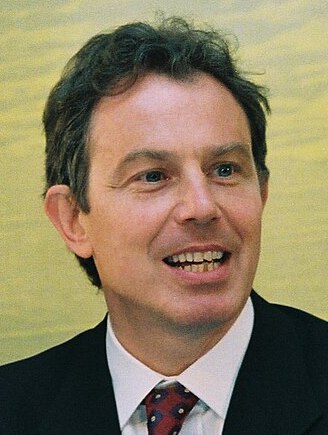
Photo by Jean Guyaux / European Communities (© 1997), licensed under CC BY 4.0 via Wikimedia Commons.
Socially liberal attitudes towards growing discussions on national identity, diversity, and multiculturalism, had been mostly cultivated by educated, insulated middle-class demographics, and somewhat alienated, or appeared distant from, traditional working-class voters and their everyday lives. Thomas Sampson, an Associate Professor of Economics at the London School of Economics, pointed to an identification with the nation-state, and a sense of ‘scapegoating’ the EU in rhetoric, as strong factors in the Leave campaign’s success, with polling data showing that older, white school leavers identified significantly more with national identity than socially liberal graduates and middle-class professionals.[44]
Work by Ford & Goodwin found declining groups tended to be more nationalistic, with national identity thought to be linked to ancestry and birthplace, more than institutions or civic attachments. They also tended to place high value in a sense of ‘order’ and ‘stability,’ defined by firm national identity and sovereignty (which could be threatened by ‘diversity, mobility and rapid change;’ the very things championed by socially liberal emerging groups).[45]
In this way, the EU, immigration, and the larger ideology of global integration could be seen as a kind of scapegoat for the ‘left-behind’ demographics and their concretely declining, institutionally overlooked, situation.[46] From this, we can surmise that some of the Leave campaign’s success is owed to the ‘Left-Behinds’ of modern Britain. This is why Guillén described the argument for a borderless world post-financial crash as a ‘political liability.’[47]

Photo by ChiralJon, licensed under CC BY 2.0 via Wikimedia Commons.
But it is in this sense that the socio-cultural effects of Globalization are somewhat disarticulated from the simultaneously solidifying economic system. While the negative effects of the system drive anxieties of ‘left-behind’ demographics, fuelling a counter-drive for ‘order and stability,’ the fundamental Thatcherite dismantling of organized labour and national industry remains decisively unchallenged.
We must therefore question whether a globalized world inevitably leads to this level of inequality, or whether a system fortified by robust domestic protections could have mitigated these percolating inequities. The tension suggests that Brexit was not an exit from the economic system itself, but a desperate, paradoxical attempt to find security in a framework that continues to prioritise capital over community.
The New Protectionism

Courtesy of the Library of Congress. Public Domain.
Considering all of this, what, then, is the alternative to Globalization proposed by the champions of Brexit?
The organized blow-back against Globalization in Brexit finds its transatlantic analogue in US President Donald Trump’s simultaneous election (mere months after the referendum result), who also successfully catalysed a ‘left-behind’ post-industrial base. As Pareschi notes, Trump himself immediately linked the two campaigns together, identifying a ‘common will’ to reclaim national sovereignty.[48] By 2026, in Trump’s second term, this ‘alternative’ in the US has evolved from rhetorical threats into a chaotic, but hardened, ethos.

Photo by The Now Time on Unsplash.
The alternative proposed by Trump is Protectionism, or: taxing imports to shelter domestic businesses from international competition. Following his return to the White House after Joe Biden, Trump escalated the trade wars of his first term[49] into a blanket ‘Declaration of Economic Independence,’[50] culminating in the April 2025 imposition of a 10% baseline tariff on almost all imports to the US.
For post-Brexit Britain (initially seeking a ‘Global Britain’ model of openness), this protectionist era has proved a costly paradox. To secure market access for its ‘crown jewel’ sectors, the UK was forced into a landmark US pharmaceutical deal,[51] effectively trading higher NHS drug-pricing thresholds for reduced tariffs.[52] In this landscape, the ‘alternative’ to globalization appears to be, not a return to 19th-century isolation, but a fragmented world of ‘trade-defence’ toolkits and bilateral concessions where sovereignty is bartered for survival.
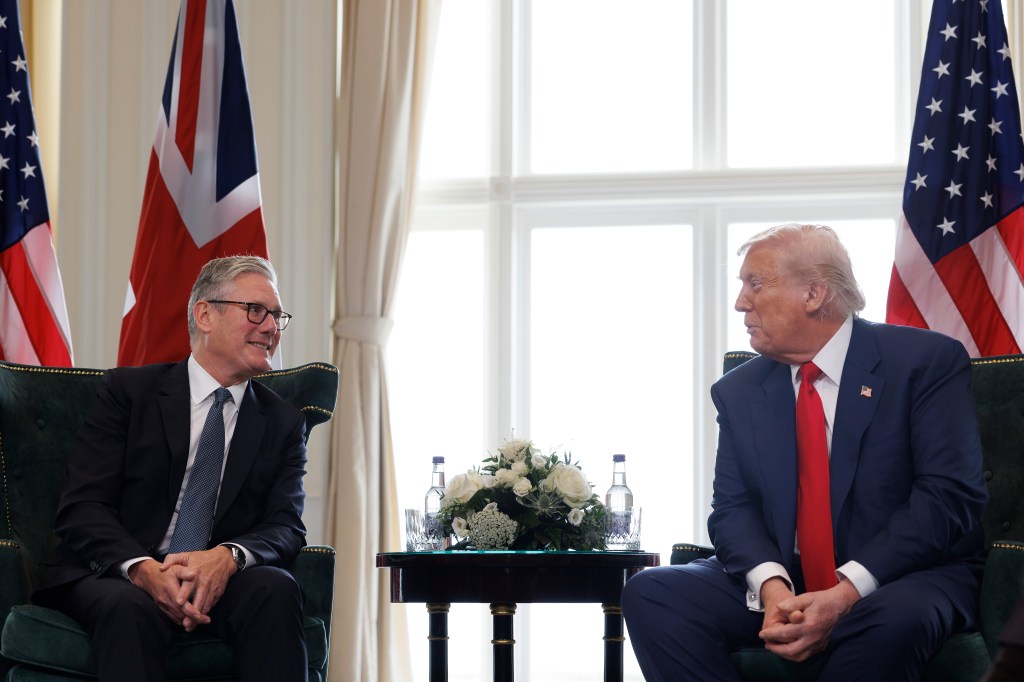
Photo by Lauren Hurley / No 10 Downing Street. © Crown copyright, licensed under OGL v3.0 via Wikimedia Commons.
American economist Jospeh Stiglitz has argued that this tactic has considerable support from billionaires and companies who compete with imports precisely because of the significant financial upside for them;[53] making it hard to see the rhetoric as anything more than a cynical manipulation of anti-globalization sentiment. By 2026, we see a stark paradox: the same corporate titans who lobbied for the 2025 ‘Liberation Day’ tariffs (ostensibly to defend the American worker) are simultaneously leading legal challenges to dismantle union rights and roll back workplace safety regulations. This suggests that their interest in the welfare of disenfranchised blue-collar workers is purely instrumental, using protectionism as a shield, not for the worker, but as a subsidized barrier to competition, allowing the continued exploitation of domestic labour without the threat of foreign intervention.[54]
Similarly, in Britain, the high-profile foreign takeovers of firms like the defence contractor Cobham Plc and the satellite operator Inmarsat Plc prompted a political shift towards protectionist rhetoric. In an effort to secure the ‘Red Wall’ post-industrial regions won over spectacularly during his 2019 election victory, Boris Johnson’s Conservative government promised to relax state-aid rules and encourage ‘Buying British.’[55]
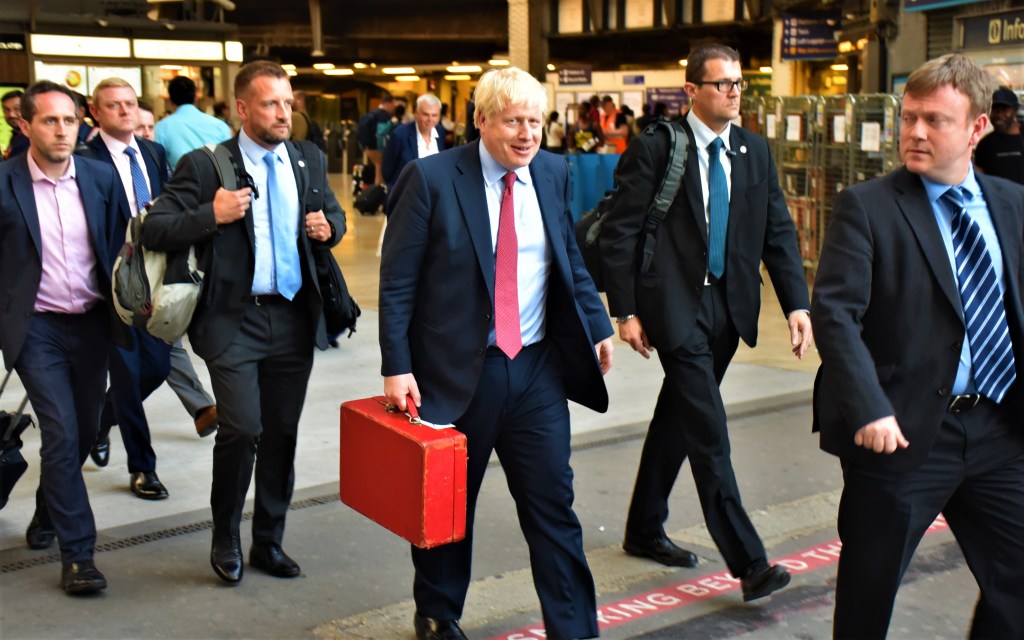
Photo by David Sedlecký, licensed under CC BY-SA 4.0 via Wikimedia Commons.
However, the narrative of New Protectionism ignores a structural reality: today, in early 2026, the service sector accounts for a staggering 81% of UK economic output,[56] whereas manufacturing has dwindled to just 8.6%.[57] This reflects a decisive lack of manufacturing apparatus in a post-Thatcher Britain that, without unprecedented levels of state investment, can’t be rebuilt.
Furthermore, the UK faces fierce competition from developing nations that have spent decades cultivating highly industrialised economies. As Stiglitz notes, even a minor resurgence in domestic manufacturing would not provide a windfall for the ‘left-behind’ demographic; modern production relies on automation and AI-driven technologies that require entirely different skill sets than those of traditional manual workers in Northern England or the Rust Belt in the US.[58] In 2026, protectionism acts less as a bridge to the industrial past, and more as a defensive screen for a nation that has fundamentally outgrown its manufacturing heritage.

Photo by Peter Xie via Pexels.
As Stiglitz reminds us, major economic transitions historically trigger more job destruction than immediate creation.[59] Consequently, a comprehensive program of deglobalization is likely to repeat this painful cycle, and the potential losses for sectors that rely on global supply chains far outweighs the marginal gains for domestic exporters. Furthermore, as Leung notes, the imposition of tariffs and quotas restricts consumer choice and inflates the cost of living.[60] In 2025 and 2026, these measures have acted as a regressive tax, disproportionately impacting the working classes whose stagnant wages are further eroded by the rising cost of essential goods. Far from protecting the ‘left-behind’ demographics, deglobalization risks entrenching their hardships within a weaker, more isolated economy.
With the absence of resurgence in manufacturing, and the mounting collateral damage to the service sector from protectionist trade frictions, the unskilled ‘left-behind’ worker remains marooned in an economy that offers little by way of a genuine alternative to Neoliberalism. In 2025 and 2026, it has become evident that the anti-globalization sentiment driving both Brexit in the UK, and Trumpism in the US, focused on the symptoms of global integration rather than the mechanisms of neoliberal neglect.
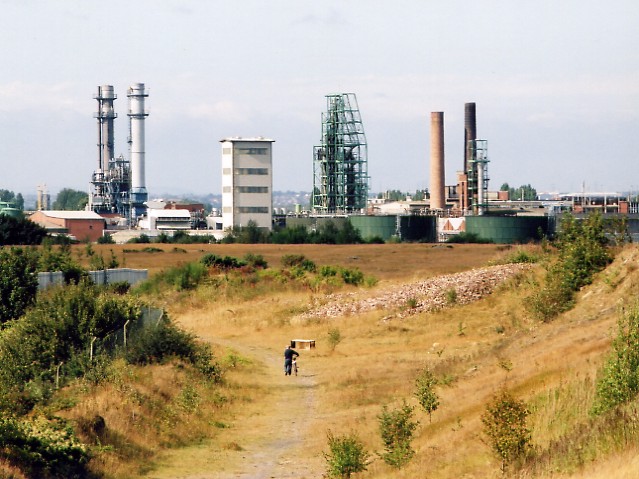
Photo by David Pickersgill, licensed under CC BY-SA 2.0 via Geograph.
By the first quarter of 2026, the UK’s regional economic gap has actually widened, with London and the South East continuing to capture over 60% of new high-value service jobs, with growth in the North East and Scotland lagging significantly below the national average.[61] Similarly, in the US, despite Trump’s ‘Liberation Day’ tariffs, manufacturing employment has actually fallen, with firms struggling over the increased cost of imported components.[62] The political sea-change of the Brexit/Trump era have not dismantled the neoliberal order, but have merely layered an ineffectual program of Protectionism on top of it, further failing to address the very inequities which catalysed that sea change.
With the ‘Red Wall’ still crumbling, and the US relationship turning toxic over Iran, ‘New Protectionism’ has been exposed as a hollow alternative, forcing Keir Starmer’s government to reconsider the UK’s relationship with Europe.

Official White House Video/Photograph by the Executive Office of the President. Public Domain, https://x.com/realDonaldTrump/status/2027651077865157033.
So, where do we go from here?
Globalization Without Neoliberalism?

In the wake of this double-failure of Neoliberal neglect and Protectionist friction, we may pose the question of whether some form of Globalization could exist without the Neoliberal policies which have so decisively skewed the balance of power.
The effects of Globalization which, for example, Collins for Forbes identifies as desirable: the influx of information between countries, cultural intermingling and the values of openness and tolerance,[63] have met with negative associations in-part because the onset of Globalization has measurably made the lives of certain demographics more difficult. But a global model could, in theory, be reconciled with a system that is fairer. So, how exactly could this happen? How could Globalization be fixed?
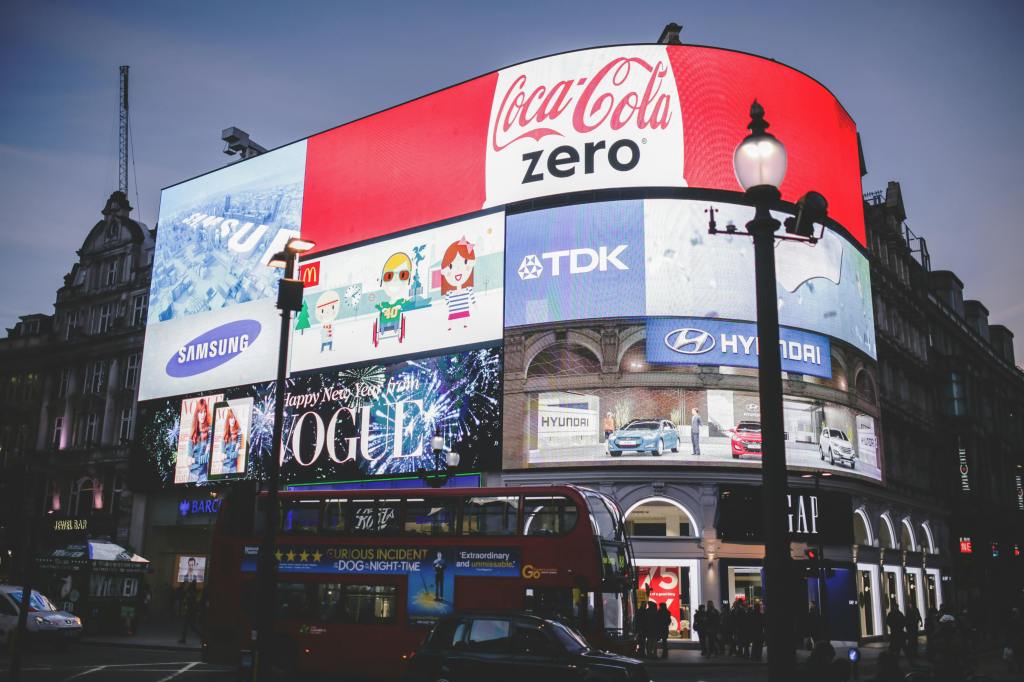
Photo of Commercial District During Dawn by Negative Space via Pexels.
On the understanding that the fabric of the global economy is that of a ‘global’ pot of capital accumulated by TNCs, growing alongside national and individual capital, which, with Neoliberal policy, has grown to subordinate the other two; Wim Dierckxsens, a Dutch social scientist and former UN administrator, argues for a ‘citizen-led, totality-based’ model, reconciling the interests of the latter with those of the former.[64]
Post-war style policies attuned to national economies are incongruous in the modern age, where the global pot of capital dwarfs national budgets. However, global interconnectedness may provide the opportunity for a new kind of regulation.
Competitiveness in the global system, Dierckxsens notes, depends on technological innovation and, thus, technological depreciation: meaning that productivity will inevitably grow more slowly than the cost of innovation, with government subsidies and accommodating fiscal policies promoting chronic underutilization of installations and accelerating this process.[65] The resulting capital flight to speculative spheres is one example of how the global system can cause job losses and the further concentration of capital to financial entities (accumulating again in global cities).
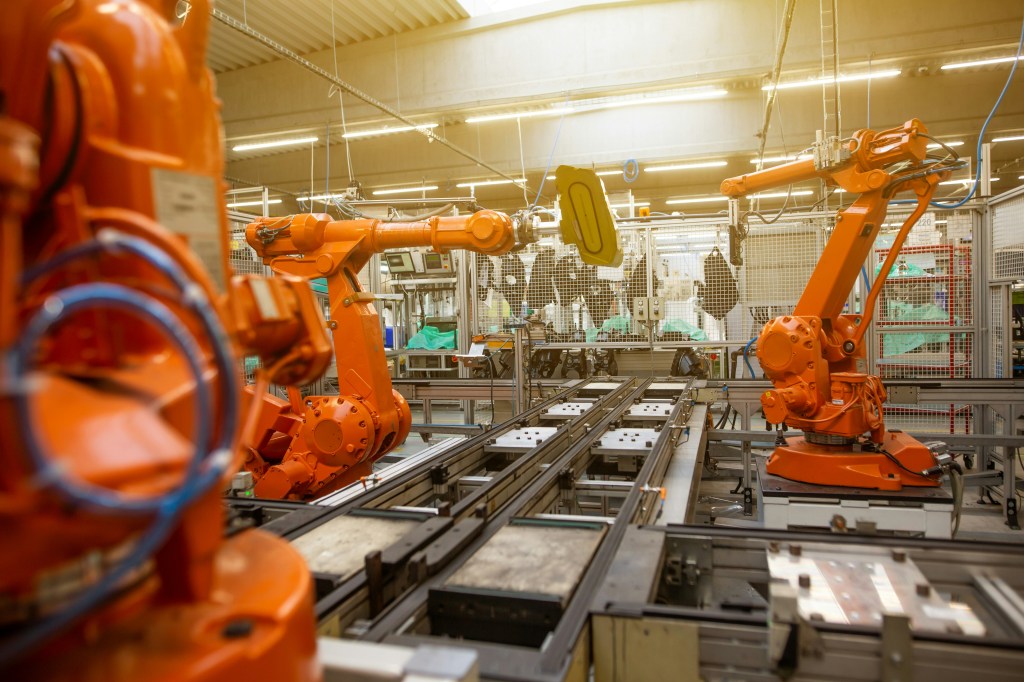
Photo by Simon Kadula on Unsplash.
As a possible solution, Dierckxsens proposes a global auditing process. In this way, technological depreciation could be monitored by credible international firms, like PwC and KPMG who already conduct ecological audits.[66] This would, however, only work on a global scale: if conducted on a national, or firm-by-firm, basis it would simply be met with greater capital flight.
In the face of this dilemma, Dierckxsens argues for a ‘global citizenry’ to put grassroots pressure on powerful agencies, like the IMF and WTO, which promote deregulation, towards changing objectives in favour of economic regulation, and acting as effective counterweights to TNCs.[67] Dierckxsens faith in grassroots organization may well be misplaced, but, by utilizing the tools of the interconnected world Globalization has provided, we could have an unprecedented opportunity for a new, international, form of unionizing.
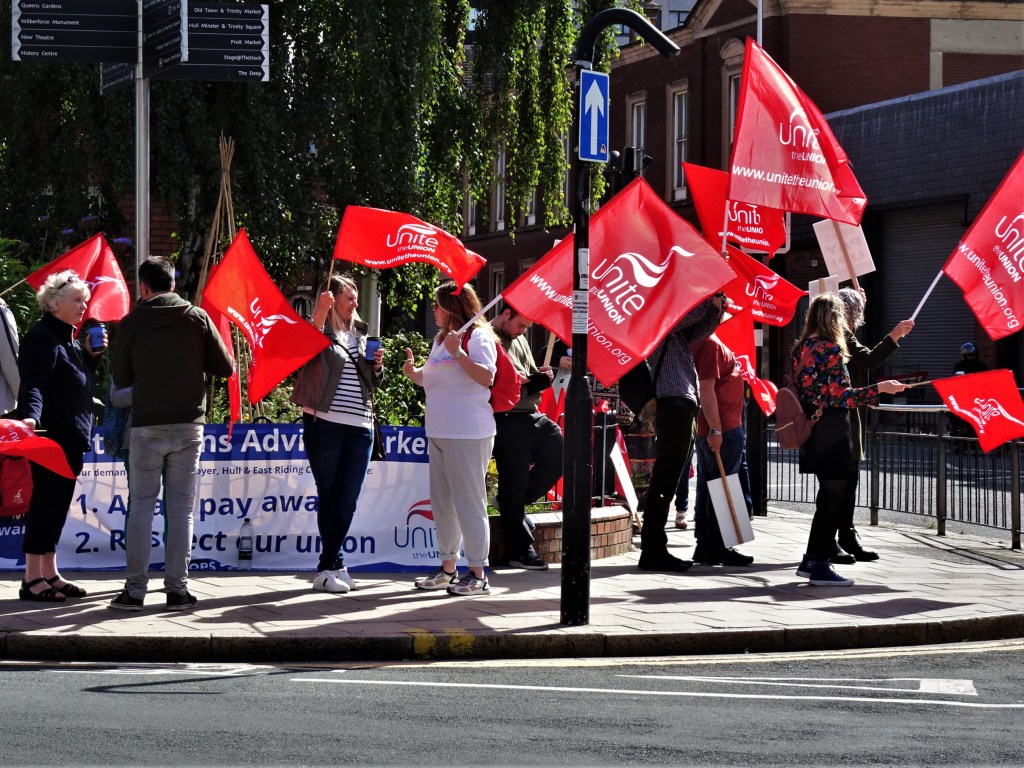
Unite trades union strike action, Kingston upon Hull.
Photo by Bernard Sharp, licensed under CC BY-SA 2.0 via Geograph.
The activism of citizen groups in the global era has more and more highlighted the abuses of power by specific TNCs on ethical grounds; one of the largest TNCs in the world, Shell, was forced by citizen opposition into formulating a code of conduct addressing child labour and forced labour for the entire corporation.[68] But to have an effect on the global network of TNCs, such activism would need to line up with other citizen groups across the globe under a common banner of regulation.
Leslie Sklair, Emeritus Professor of Sociology at the London School of Economics and Political Science, argues that a Capitalist Globalization, which relies so heavily on technology, not only for transport innovation, but also for mass communication and electronic marketing, makes implicit in its concept an emancipatory potential. This is because it cannot prevent counter-hegemonic challenges on the internet or related media.[69]
The twin desires of hegemony and openness cannot be reconciled. The potential for mobilizing discontent on, for example, high-speed networks like X or TikTok, are unprecedented. Any claim made in the interests of global capital could almost instantaneously be challenged by insurgent forces with first-hand testimony, or counter-evidence. This was demonstrated in the 2025 #MakeAmazonPay global strikes, where a ‘digital picket line’ was synchronised across thirty countries, hitting the corporation’s logistical spine on its most profitable day.[70]
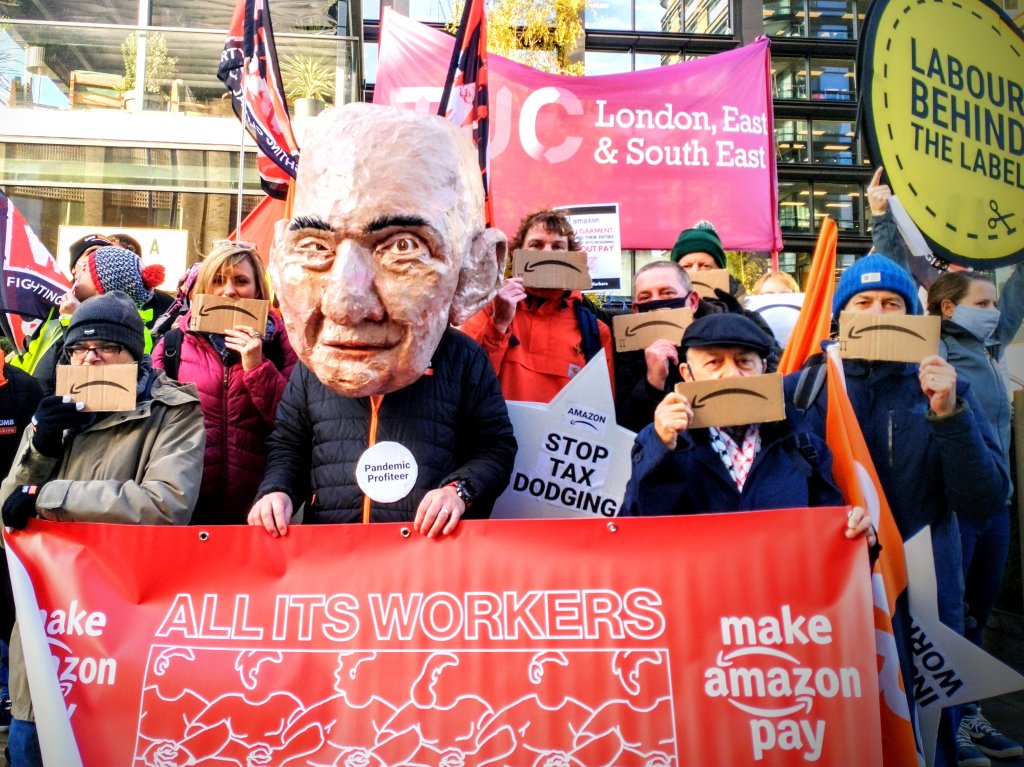
Photo by War on Want, licensed under CC BY 2.0 via Wikimedia Commons.
Such a movement, though, would, more than anything else, be a substantial project of global education and consciousness-raising on the economic, ecological and ethical concerns surrounding Globalization. The ability to do so, however, is closer than ever. Contained within the technological innovations so instrumental to global capital are Sklair’s ‘seeds of divergence.’[71] A citizen-based global network could, in theory, coalesce into a kind of international labour union, pressuring governments and regulatory boards to regulate markets and force TNCs to comply, under threat of co-ordinated global strikes. The 2026 UK-wide Uber ‘log-off’ strike serves as a blueprint for this: by collectively withdrawing their data and labour from the app, a decentralised workforce successfully broke the algorithmic management of a global platform.[72]
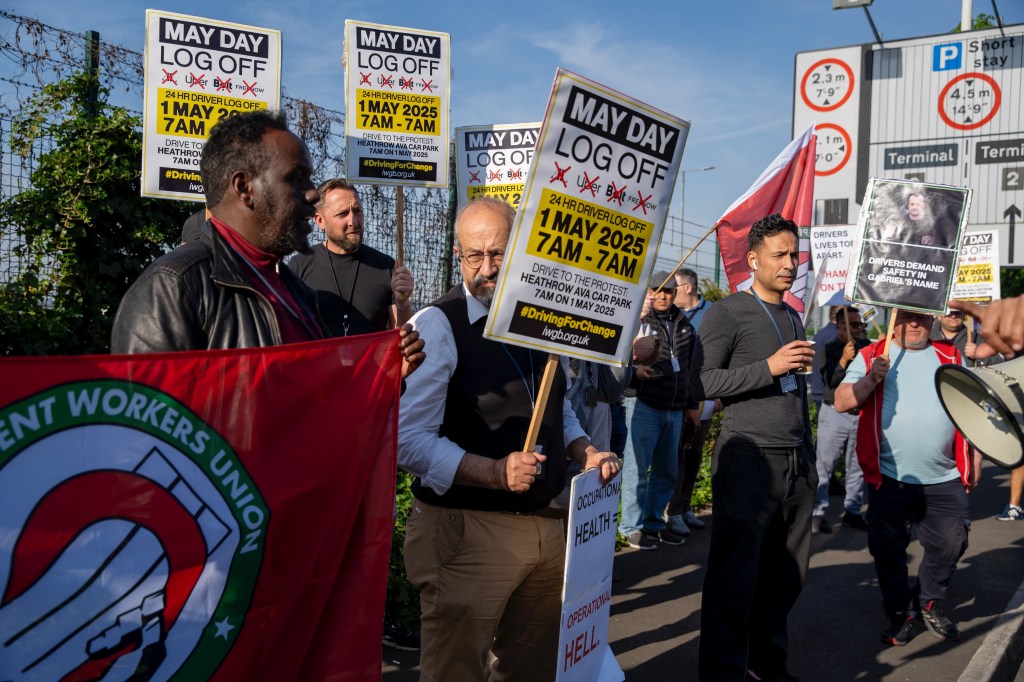
Photo via IWGB Union on X. Used for editorial commentary.
This could bring the state and markets back into closer alignment by eliminating the loopholes and replacing the global network of TNCs with a kind of international network of national economies, preventing the chaos of an unregulated global market while enjoying the benefits of open communication and international connectivity.
There is the potential for a global interconnectedness without Neoliberalism, but it would ultimately be subject to shifts in political will and awareness which would require a program of global mobilization. Perhaps, ultimately, the most damaging and consequential effect of Neoliberalism in the West has been its thorough deterioration of popular class-consciousness. For this reason, it seems that, for now, Globalization and Neoliberalism are largely synonymous, with the feasibility of the former being contingent on the latter, the nurtured inequalities of which having asserted corporeality through the Brexit vote and the election of Donald Trump.

Photo by Milliped, licensed under CC BY-SA 4.0 via Wikimedia Commons.
The question isn’t whether globalization can exist without Neoliberalism, but whether the political will exists to make it fair. The political landscape to mobilize discontent doesn’t appear readily available; but, in this great digital age, the structural tools of a collective, global citizenry may be closer than ever before.
[1] Parker G, ‘Keir Starmer signals major UK pivot towards EU after Donald Trump’s taunts,’ The Independent, 1st April (2026), https://www.ft.com/content/9f3d05e0-d684-40be-8ecb-b8c9e69ddda5?syn-25a6b1a6=1
[2] Hajdari U, ‘A decade of Brexit: Britain falls behind peers in trade and growth,’ Euronews, 3rd December (2025), https://www.euronews.com/business/2025/12/03/a-decade-of-brexit-britain-falls-behind-peers-in-trade-and-growth
[3] Bloom N, Bunn P, Mizen P, Smietanka P, Thwaites G, ‘The Economic Impact of Brexit,’ NBER Working Paper 34459 (2025), https://doi.org/10.3386/w34459
[4] Elliott L, ‘Brexit is a rejection of globalisation,’ The Guardian, 26th June (2016).
[5] ‘Elites in the political classes as well as middle class ‘cosmopolitans’ appear to have lost any awareness or reflexivity in understanding, or acknowledging working class experience without lapse towards demonizing and sermonizing,’ McKenzie L, ‘The class politics of prejudice: Brexit and the land of no-hope and glory,’ The British Journal of Sociology (68), (2017), p. 4.
[6] Alabrese E, Becker S O, Fetzer T, Novy D, ‘Who voted for Brexit? Individual and regional data combined,’ European Journal of Political Economy (56), (2019), pp. 132-150, p. 133.
[7] Lord Ashcroft Polls, ‘How the UK voted on Brexit, and why: a refresher,’ 4th February (2016), https://lordashcroftpolls.com/2019/02/how-the-uk-voted-on-brexit-and-why-a-refresher/.
[8] Ford R, Goodwin M, ‘Britain After Brexit: A Nation Divided,’ Journal of Democracy, Vol. 28, No. 1, January (2017), pp. 17-30, p. 19.
[9] Niggle C J, ‘Globalization, Neoliberalism and the Attack on Social Security,’ Review of Social Economy, Vol. 61, No. 1, March (2003), pp. 51-71, p. 60-1.
[10] Edgerton D, ‘How Britain was sold,’ New Statesman, 15-21st November (2019), pp. 23-5, p.23.
[11] Nunn A, ‘The contested and contingent outcomes of Thatcherism in the UK,’ Capital & Class, Vol. 38, No. 2, (2014), pp. 303-321, p. 313.
[12] Edgerton D, ‘How Britain was sold,’ New Statesman, 15-21st November (2019), pp. 23-5, p.23.
[13] Niggle, p. 61.
[14] Ball J, ‘The Thatcher effect: what changed and what stayed the same,’ The Guardian, 12th April (2013).
[15] Silverwood J, Woodward R, ‘The Schizophrenia of UK (De) industrialisation Policy,’ Sheffield Political Economy Research Institute, 1st October (2018).
[16] Hall S, ‘The Neoliberal Revolution,’ Cultural Studies, Vol. 25, No. 6, (2011), pp. 705-28, p. 12.
[17] ‘No developed state, with the exception of New Zealand, suffered such a brutal widening of inequality.… Child poverty more than doubled,’ Dean M, ‘Margaret Thatcher’s policies hit the poor hardest – and it’s happening again,’ The Guardian, 9th April (2013).
[18] Pyper D, ‘Trade union legislation 1979-2010,’ House of Commons Library, Briefing Paper, No. CBP 7882, 26th January (2017).
[19] Nunn, p. 317.
[20] Toly N, ‘Brexit, Global Cities, and the Future of World Order,’ Globalizations, Vol. 14, No. 1, (2017), pp. 142-9, p. 143.
[21] Robertson J, ‘How the Big Bang changed the City of London for ever,’ BBC News, 27th October (2016), https://www.bbc.co.uk/news/business-37751599.
[22] Coelho M, Ratnoo V, Dellepiane S, ‘The Political Economy of Infrastructure in the UK,’ Economic & Social Research Council, (2014), p. 22-3.
[23] ‘The UK’ in this instance only meaning England and Wales, as Scotland’s water remains publicly owned (Scottish Water).
[24] Raikes L, Giovannini A, Getzel B, ‘Divided and Connected: State of the North 2019,’ Institute for Public Policy Research, IPR North: Manchester, November (2019), p. 12.
[25] Toly, p. 142-3.
[26] Dijkstra L, Poelman H, Rodríguez-Pose A, ‘The Geography of EU Discontent,’ The European Commission, Publications Office of the European Union: Luxembourg, December (2018), p. 19.
[27] Ibid. p. 18-9.
[28] Raikes, Giovannini, Getzel, p. 14.
[29] Chakelian A, ‘“A revolt of the regions”: Could Gordon Brown’s federal UK plan become Labour Brexit policy?’ The Independent, 3rd November (2016).
[30] Ibid.
[31] Pyper.
[32] Friedman TL, The World Is Flat: A Brief History of the Twenty-First Century, Farrar, Straus and Giroux: USA (2005), p. 8.
[33] Florida R, ‘The World is Spiky,’ The Atlantic, October (2005), pp. 48-51, p. 50-1.
[34] Dörry S, Dymski G, ‘Will Brexit reverse the centralizing momentum of global finance?’ Geoforum, Available Online: https://www.sciencedirect.com/science/article/pii/S0016718518300393?via%3Dihub, 21st February (2018), p. 2.
[35] Office for National Statistics, ‘Regional gross value added (income approach), UK: 1997 to 2016,’ ONS Statistical Bulletin, 20th December (2017), Available Online: www.ons.gov.uk, p. 5.
[36] Dörry, Dymski, p. 1.
[37] New Financial, ‘Brexit & The City: The Impact So Far,’ New Financial Research, March (2024), Available Online: https://www.newfinancial.org/reports/brexit-%26-the-city%3A-the-impact-so-far, p. 2.
[38] O’Grady S, ‘What will really happen if the City leaves the single market?’ The Independent, 19th December (2017).
[39] Rodríguez-Pose A, ‘The revenge of the places that don’t matter: left-behind places and the rise of populism,’ Cambridge Journal of Regions, Economy and Society, Vol. 11, No. 1 (2018), pp. 189–209, p. 189.
[40] Guillén M, ‘The Demise of the Global Liberal Order,’ Survival, (61:2), (2019), pp. 87-90, p. 89.
[41] Ford, Goodwin, p. 19.
[42] Ibid., p. 18.
[43] ‘(David) Cameron’s modernisation strategy in this area was based on sending signals that the party had changed (or at least was changing) by striking a deliberately different tone on equality issues,’ Hayton R, McEnhill L, ‘Cameron’s Conservative Party, social liberalism and social justice,’ British Politics, Vol. 10, No. 2, June (2015), pp. 131-147, p. 137.
[44] Sampson T, ‘Brexit: The Economics of International Disintegration,’ The Journal of Economic Perspectives, Vol. 31, No. 4, Fall (2017), pp. 163-184, p. 179.
[45] Ford, Goodwin, p. 19.
[46] Ibid., p. 19-20.
[47] Guillén, p. 89-90.
[48] Pareschi A, ‘At a Crossroads or Business as Usual? British Foreign Policy and the International Order in the Wake of Brexit-Trump,’ Interdisciplinary Political Studies, Vol. 1, No. 4, July (2018), pp. 115-151, p. 166.
[49] Frankel J, ‘Trump’s trade wars and Brexit are making us all poorer,’ The Guardian, 27th November (2018).
[50] Trump D, ‘Rose Garden Remarks on Liberation Day,’ White House Briefing, 2nd April (2025), p. 1.
[51] Department for Business and Trade, ‘Landmark UK-US pharmaceuticals deal to safeguard medicines access,’ GOV.UK, 1st December (2025), Available Online: https://www.gov.uk/government/news/landmark-uk-us-pharmaceuticals-deal-to-safeguard-medicines-access-and-drive-vital-investmentfor-uk-patients-and-businesses, p. 1.
[52] Nuffield Trust, ‘Impact of US-UK pharmaceutical deal on NHS budgets,’ BBC News, 1st December (2025), Available Online: https://www.bbc.co.uk/news/articles/cn0k520v4xro, p. 2.
[53] Stiglitz J, Globalization and its Discontents Revisited, Penguin Books, Random House: UK (2017), p. 55.
[54] Glass A, ‘US union elections declined in 2025 after Trump hobbled labor board,’ Center for American Progress, 11th February (2026), Available Online: https://www.theguardian.com/us-news/2026/feb/11/labor-relations-board-nlrb-unions-trump, p. 2.
[55] Evans E, ‘Johnson Tries ‘Trumpian Protectionism’ to Woo Labour Brexit Vote,’ Bloomberg, 29th November (2019).
[56] House of Commons Library, ‘Service industries: Economic indicators,’ Research Briefing, 25th March (2026), Available Online: commonslibrary.parliament.uk, p. 2.
[57] House of Commons Library, ‘Manufacturing industries: Economic indicators,’ Research Briefing, 13th March (2026), Available Online: commonslibrary.parliament.uk, p. 1.
[58] Stiglitz, p. 57.
[59] Ibid., p. 60-1.
[60] Leung C K, ‘Protectionism Actually Hurts U.S. Jobs And Economy: An Investigation Of Proponents And Opponents,’ International Business & Economics Research Journal, Vol. 5, No. 9, September (2006), p. 2.
[61] EY, ‘UK regional economic gap set to widen over the next three years,’ EY UK Regional Economic Forecast 2025, 19th March (2025), Available Online: https://www.ey.com/en_uk/newsroom/2025/03/uk-economy-gap-to-widen-ref-2025, p. 1.
[62] Independent, ‘Trump tariffs were supposed to save manufacturing jobs, but data shows the opposite,’ The Independent, 15th January (2026), Available Online: https://www.independent.co.uk/news/world/americas/us-politics/trump-tariffs-manufacturing-jobs-data-b2901425.html.
[63] Collins M, ‘The Pros and Cons of Globalization,’ Forbes, Forbes Media LLC, 6th May (2015).
[64] Dierckxsens W, ‘Towards a Citizen-based Alternative,’ The Limits of Capitalism: An Approach to Globalization Without Neo-Liberalism, St. Martins Press, Inc: New York (2000), pp. 134-55, p. 134.
[65] Ibid., p. 144.
[66] Ibid., p. 144.
[67] Ibid., p. 150.
[68] Ibid., p. 103.
[69] Sklair L, ‘The Emancipatory Potential of Generic Globalization,’ Globalizations, Vol. 6, No. 4, December (2009), pp. 525-39, p. 530.
[70] UNI Global Union, ‘Thousands of Amazon workers strike in dozens of countries on Black Friday,’ UNI Global News, 26th November (2025).
[71] Ibid., p. 538.
[72] App Drivers & Couriers Union, ‘ADCU calls national strike against Uber over pricing and commission,’ ADCU News, 20th January (2026), Available Online: https://www.adcu.org.uk/news-posts/adcu-calls-national-strike-against-uber.
Bibliography
Alabrese E, Becker S O, Fetzer T, Novy D, ‘Who voted for Brexit? Individual and regional data combined,’ European Journal of Political Economy (56), (2019), pp. 132-150.
App Drivers & Couriers Union, ‘ADCU calls national strike against Uber over pricing and commission,’ ADCU News, 20th January (2026), Available Online: https://www.adcu.org.uk/news-posts/adcu-calls-national-strike-against-uber.
Ball J, ‘The Thatcher effect: what changed and what stayed the same,’ The Guardian, 12th April (2013).
Bloom N, Bunn P, Mizen P, Smietanka P, Thwaites G, ‘The Economic Impact of Brexit,’ NBER Working Paper 34459 (2025), Available Online: https://doi.org/10.3386/w34459.
Chakelian A, ‘“A revolt of the regions”: Could Gordon Brown’s federal UK plan become Labour Brexit policy?’ The Independent, 3rd November (2016).
Coelho M, Ratnoo V, Dellepiane S, ‘The Political Economy of Infrastructure in the UK,’ Economic & Social Research Council, (2014).
Collins M, ‘The Pros and Cons of Globalization,’ Forbes, Forbes Media LLC, 6th May (2015).
Dean M, ‘Margaret Thatcher’s policies hit the poor hardest – and it’s happening again,’ The Guardian, 9th April (2013).
Department for Business and Trade, ‘Landmark UK-US pharmaceuticals deal to safeguard medicines access,’ GOV.UK, 1st December (2025), Available Online: https://www.gov.uk/government/news/landmark-uk-us-pharmaceuticals-deal-to-safeguard-medicines-access-and-drive-vital-investmentfor-uk-patients-and-businesses.
Dierckxsens W, ‘Towards a Citizen-based Alternative,’ The Limits of Capitalism: An Approach to Globalization Without Neo-Liberalism, St. Martins Press, Inc: New York (2000), pp. 134-55.
Dijkstra L, Poelman H, Rodríguez-Pose A, ‘The Geography of EU Discontent,’ The European Commission, Publications Office of the European Union: Luxembourg, December (2018).
Dörry S, Dymski G, ‘Will Brexit reverse the centralizing momentum of global finance?’ Geoforum, 21st February (2018), Available Online: https://www.sciencedirect.com/science/article/pii/S0016718518300393?via%3Dihub.
Edgerton D, ‘How Britain was sold,’ New Statesman, 15-21st November (2019), pp. 23-5.
Elliott L, ‘Brexit is a rejection of globalisation,’ The Guardian, 26th June (2016).
Evans E, ‘Johnson Tries ‘Trumpian Protectionism’ to Woo Labour Brexit Vote,’ Bloomberg, 29th November (2019).
EY, ‘UK regional economic gap set to widen over the next three years,’ EY UK Regional Economic Forecast 2025, 19th March (2025), Available Online: https://www.ey.com/en_uk/newsroom/2025/03/uk-economy-gap-to-widen-ref-2025.
Florida R, ‘The World is Spiky,’ The Atlantic, October (2005), pp. 48-51.
Ford R, Goodwin M, ‘Britain After Brexit: A Nation Divided,’ Journal of Democracy, Vol. 28, No. 1, January (2017), pp. 17-30.
Friedman TL, The World Is Flat: A Brief History of the Twenty-First Century, Farrar, Straus and Giroux: USA (2005).
Glass A, ‘US union elections declined in 2025 after Trump hobbled labor board,’ Center for American Progress, 11th February (2026), Available Online: https://www.theguardian.com/us-news/2026/feb/11/labor-relations-board-nlrb-unions-trump.
Guillén M, ‘The Demise of the Global Liberal Order,’ Survival, (61:2), (2019), pp. 87-90.
Hajdari U, ‘A decade of Brexit: Britain falls behind peers in trade and growth,’ Euronews, 3rd December (2025), https://www.euronews.com/business/2025/12/03/a-decade-of-brexit-britain-falls-behind-peers-in-trade-and-growth.
Hall S, ‘The Neoliberal Revolution,’ Cultural Studies, Vol. 25, No. 6, (2011), pp. 705-28.
Hayton R, McEnhill L, ‘Cameron’s Conservative Party, social liberalism and social justice,’ British Politics, Vol. 10, No. 2, June (2015), pp. 131-147.
House of Commons Library, ‘Service industries: Economic indicators,’ Research Briefing, 25th March (2026), Available Online: commonslibrary.parliament.uk.
House of Commons Library, ‘Manufacturing industries: Economic indicators,’ Research Briefing, 13th March (2026), Available Online: commonslibrary.parliament.uk.
Independent, ‘Trump tariffs were supposed to save manufacturing jobs, but data shows the opposite,’ The Independent, 15th January (2026), Available Online: https://www.independent.co.uk/news/world/americas/us-politics/trump-tariffs-manufacturing-jobs-data-b2901425.html.
Leung C K, ‘Protectionism Actually Hurts U.S. Jobs And Economy: An Investigation Of Proponents And Opponents,’ International Business & Economics Research Journal, Vol. 5, No. 9, September (2006).
Lord Ashcroft Polls, ‘How the UK voted on Brexit, and why: a refresher,’ 4th February (2016), https://lordashcroftpolls.com/2019/02/how-the-uk-voted-on-brexit-and-why-a-refresher/.
McKenzie L, ‘The class politics of prejudice: Brexit and the land of no-hope and glory,’ The British Journal of Sociology (68), (2017).
New Financial, ‘Brexit & The City: The Impact So Far,’ New Financial Research, March (2024), Available Online: https://www.newfinancial.org/reports/brexit-%26-the-city%3A-the-impact-so-far.
Niggle C J, ‘Globalization, Neoliberalism and the Attack on Social Security,’ Review of Social Economy, Vol. 61, No. 1, March (2003), pp. 51-71.
Nuffield Trust, ‘Impact of US-UK pharmaceutical deal on NHS budgets,’ BBC News, 1st December (2025), Available Online: https://www.bbc.co.uk/news/articles/cn0k520v4xro.
Nunn A, ‘The contested and contingent outcomes of Thatcherism in the UK,’ Capital & Class, Vol. 38, No. 2, (2014), pp. 303-321.
O’Grady S, ‘What will really happen if the City leaves the single market?’ The Independent, 19th December (2017).
Office for National Statistics, ‘Regional gross value added (income approach), UK: 1997 to 2016,’ ONS Statistical Bulletin, 20th December (2017), Available Online: www.ons.gov.uk.
Pareschi A, ‘At a Crossroads or Business as Usual? British Foreign Policy and the International Order in the Wake of Brexit-Trump,’ Interdisciplinary Political Studies, Vol. 1, No. 4, July (2018), pp. 115-151.
Parker G, ‘Keir Starmer signals major UK pivot towards EU after Donald Trump’s taunts,’ The Independent, 1st April (2026), https://www.ft.com/content/9f3d05e0-d684-40be-8ecb-b8c9e69ddda5?syn-25a6b1a6=1.
Pyper D, ‘Trade union legislation 1979-2010,’ House of Commons Library, Briefing Paper, No. CBP 7882, 26th January (2017).
Raikes L, Giovannini A, Getzel B, ‘Divided and Connected: State of the North 2019,’ Institute for Public Policy Research, IPR North: Manchester, November (2019).
Robertson J, ‘How the Big Bang changed the City of London for ever,’ BBC News, 27th October (2016), https://www.bbc.co.uk/news/business-37751599.
Rodríguez-Pose A, ‘The revenge of the places that don’t matter: left-behind places and the rise of populism,’ Cambridge Journal of Regions, Economy and Society, Vol. 11, No. 1 (2018), pp. 189–209.
Sampson T, ‘Brexit: The Economics of International Disintegration,’ The Journal of Economic Perspectives, Vol. 31, No. 4, Fall (2017), pp. 163-184.
Silverwood J, Woodward R, ‘The Schizophrenia of UK (De) industrialisation Policy,’ Sheffield Political Economy Research Institute, 1st October (2018).
Sklair L, ‘The Emancipatory Potential of Generic Globalization,’ Globalizations, Vol. 6, No. 4, December (2009), pp. 525-39.
Stiglitz J, Globalization and its Discontents Revisited, Penguin Books, Random House: UK (2017).
Trump D, ‘Rose Garden Remarks on Liberation Day,’ White House Briefing, 2nd April (2025).
Toly N, ‘Brexit, Global Cities, and the Future of World Order,’ Globalizations, Vol. 14, No. 1, (2017), pp. 142-9.
UNI Global Union, ‘Thousands of Amazon workers strike in dozens of countries on Black Friday,’ UNI Global News, 26th November (2025).

 word virus